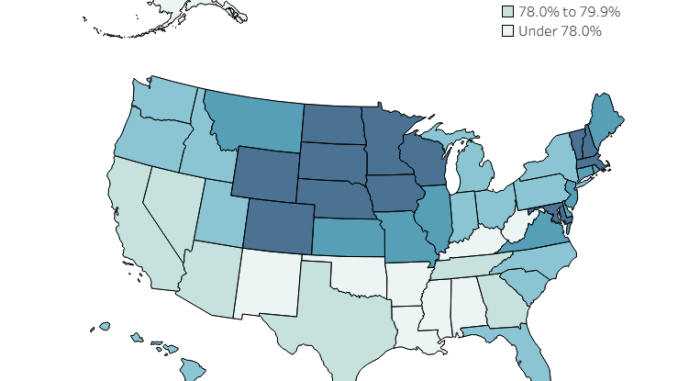

Note: Prime-age employment is based on ACS 1-year estimates. Labor force participation and unemployment are monthly BLS labor market measures. Higher values generally indicate stronger labor market attachment for prime-age employment and labor force participation, while higher unemployment indicates greater labor market distress.
About the THRIVE State Economic Conditions Explorer
The THRIVE State Economic Conditions Explorer brings together key labor market measures to help users understand how states compare on economic opportunity and connection to work. The tool currently includes three indicators: labor force participation, prime-age employment, and unemployment. Prime-age employment is based on the U.S. Census Bureau’s 2024 American Community Survey 1-Year Estimates, focused on the civilian population ages 25 to 54. Labor force participation and unemployment use monthly state labor market data from the U.S. Bureau of Labor Statistics, allowing users to compare more current economic conditions across states.
This tool was created as part of Overflow Data’s broader effort to use data to explore the founding principles of life, liberty, and the pursuit of happiness. Economic conditions are not the whole story of whether people or communities are thriving, but they are an important part of that story. Work can provide income, stability, purpose, and a path toward greater opportunity. By focusing on measures such as employment, participation, and unemployment, this explorer helps show where people are more connected to the labor market and where economic barriers may be more visible.
The explorer can be used to compare states, identify regional patterns, and better understand how different measures tell different parts of the economic story. A state with low unemployment may still have weaker labor force participation, while a state with strong prime-age employment may look different from one with a broader working-age population measure. By allowing users to switch between indicators, maps, rankings, and distribution views, the tool helps users move beyond a single headline number and develop a more complete view of state economic conditions.
Ultimately, THRIVE is designed to help users think about what it means for communities to prosper. The Economic Conditions Explorer is one piece of that larger effort, providing a clear, accessible way to examine whether people are connected to work and economic opportunity. These data can support public discussion, local planning, policy conversations, grant writing, journalism, and general exploration of how states differ in their economic foundations.
Data Sources and Tools
This tool was built in Tableau and uses U.S. Census Bureau American Community Survey 1-year estimates for prime-age employment and U.S. Bureau of Labor Statistics data for labor force participation and unemployment.
Leave a Reply